Abstract
Introduction
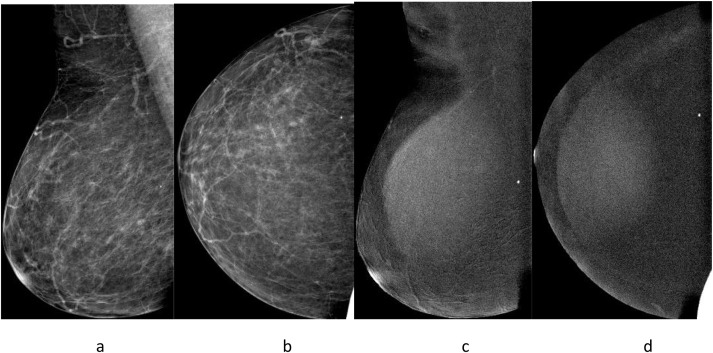
High breast density impairs mammographic cancer detection. We investigated if contrast-enhanced spectral mammography (CESM) performance is less affected by density compared to conventional mammography, addressing this critical gap.
Methods
This study retrospectively included 326 adult female patients. The study protocol was pre-registered on the Open Science Framework (OSF) platform. Each image was annotated and evaluated by a minimum of two expert radiologists, while a team of radiologists produced detailed medical reports and manual segmentation annotations for abnormal findings. The reference standards for lesion classification included follow-up assessments and pathological evaluations.
Results
The overall malignant breast lesion diagnosis for CESM yielded a sensitivity of 95.4 % (95 % CI = 92.4 %–97.5 %) and a specificity of 94.0 % (95 % CI = 91.8 %–95.7 %). Conventional mammography demonstrated a sensitivity of 85.0 % (CI = 80.5 %–88.8 %) and a specificity of 93.5 % (95 % CI = 91.3 %–95.3 %), which were both slightly lower than those achieved with CESM. In level A density, both conventional mammography and CESM demonstrated complete sensitivity and specificity. At density levels B, C, and D, CESM demonstrated higher sensitivity and specificity than conventional mammography.
Conclusion
Our findings indicate that as breast density transitions from fatty (level A) to dense (level D), CESM retains its sensitivity, while conventional mammography shows a decrease. Integrating CESM into clinics could enhance reporting systems and facilitate clinical decision-making, especially for patients with dense breast tissue.
Implications for practice
CESM showed superior diagnostic performance in the detection of malignant lesions compared to conventional mammography. CESM retains its diagnostic performance at varying levels of breast densities in contrast to conventional mammography.