Abstract
Objective
To investigate the potential of 3′-deoxy-3′-[18F]fluorothymidine positron emission tomography computed tomography ([18F]FLT PET/CT) in predicting locally advanced breast cancer response to neoadjuvant chemotherapy (NAC), focusing on the role of tumor to background parenchymal ratio (TBR) of the standardized uptake value (SUV) ratios.
Methods
This retrospective analysis utilized prospectively collected data from the multicenter ACRIN 6688 observational trial. It used a dataset of 90 patients from 17 centers with confirmed breast cancer who planned to receive NAC followed by surgery as part of their treatment. Three [18F]FLT PET/CTs were scheduled for each participant at three time points to obtain serial tumor dimensions and TBR values of SUV ratios: before therapy initiation, after completion of the first cycle, and after the termination of chemotherapy.
Results
Tumor size, TBRmean, and TBRmax all showed poor diagnostic performance in predicting pathological response in all three scans, with the highest AUC of 0.682. The combined model of PET and CT parameters exhibited the best diagnostic performance, significantly improving the diagnostic values of the first and third PET/CT scans, with AUCs of 0.731 and 0.833 for each scan and 0.875 for their percentage change. The mid-NAC scan did not seem to show any considerable diagnostic value in either of the models, with the highest AUC being 0.626.
Conclusion
The combined model, having both tumor size and uptake values as its components, performed well in predicting the tumor’s pathological response to chemotherapy, particularly when compared to each component’s performance alone, which suggests the complementary role of functional (i.e., TBR) and anatomical (i.e., size) parameters.
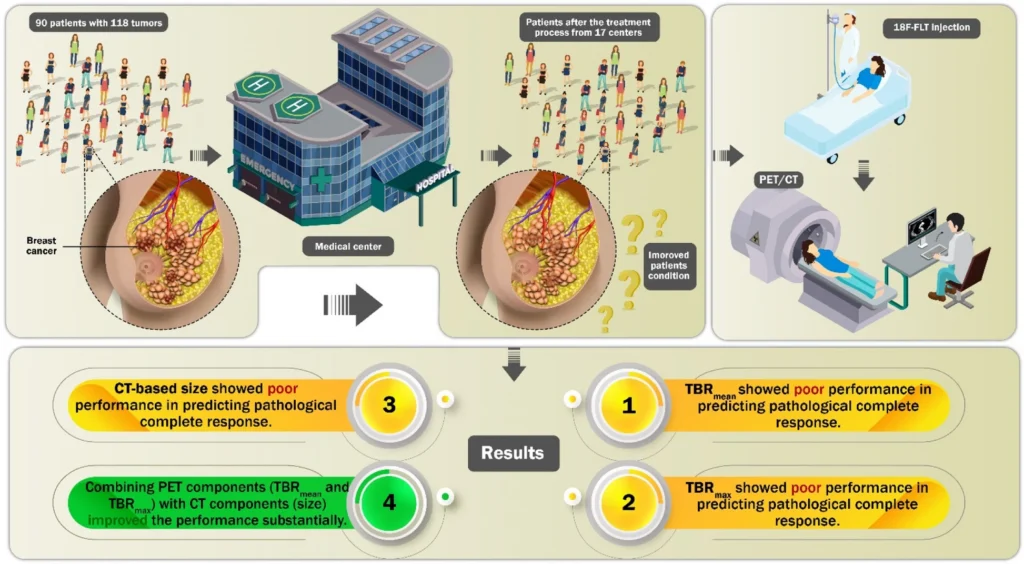
Graphical summary presenting the main findings of the study.